
If your hair frizzy even after conditioner leaves you confused, you’re not alone. Conditioner is supposed to smooth and soften, yet for many people, hair still puffs up, feels rough, or looks unruly right after rinsing it out. The truth is, conditioner addresses only surface-level hydration — it can’t fix several deeper issues that are often the real cause behind persistent frizz.
Hair Frizzy Even After Conditioner: What’s Really Going On
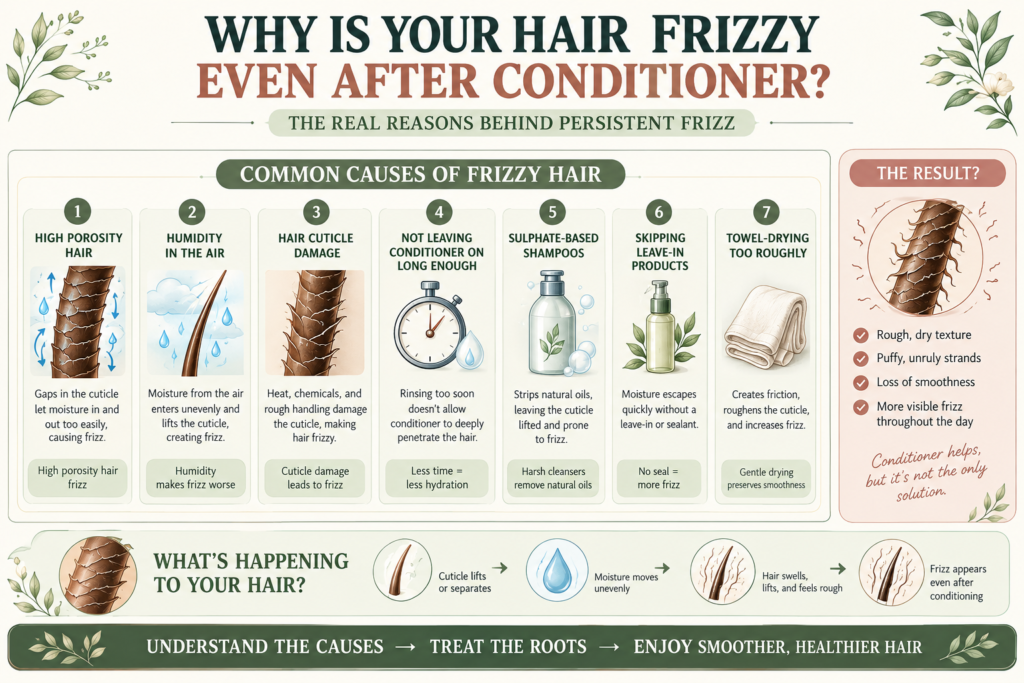
Frizz happens when the hair cuticle — the outermost protective layer of each strand — lifts or separates instead of lying flat. When this happens, moisture moves unevenly through the hair, causing strands to swell, lift, and appear rough or fuzzy. Conditioner smooths this temporarily, but if the underlying cause isn’t addressed, the effect fades quickly.
Common Causes of Frizzy Hair
Here are the most common causes of frizzy hair that conditioner alone can’t fix:
1. High Porosity Hair
High porosity hair frizz happens when the cuticle has gaps or is raised, allowing moisture to escape as easily as it enters. This makes hair especially reactive to humidity, since it absorbs moisture unevenly from the air, causing the swelling and lifting that creates frizz.
2. Humidity in the Air
Even well-conditioned hair can frizz in humid conditions if there’s underlying dryness. Water molecules from the air enter the hair shaft unevenly, disrupting the smooth, flat cuticle structure that keeps hair looking sleek.
3. Hair Cuticle Damage
Hair cuticle damage from heat styling, chemical treatments, or rough handling weakens the outer layer of each strand. Once damaged, this layer can’t seal moisture in effectively, making hair more prone to frizz regardless of how much conditioner is applied.
4. Not Leaving Conditioner On Long Enough
Rinsing conditioner out within seconds means you’re only getting surface slip, not the deeper hydration hair actually needs. Conditioner requires a few minutes of contact time to properly penetrate the hair shaft and restore moisture from within.
5. Sulphate-Based Shampoos
Harsh sulphates clean effectively but strip away the natural oils that help keep the cuticle lying flat. Once those oils are gone, the cuticle lifts, and frizz can set in even before conditioner gets a chance to help.
6. Skipping Leave-In Products
A rinse-out conditioner alone often isn’t enough to lock in moisture throughout the day. Without a leave-in product or lightweight sealant, hydration escapes quickly, especially in dry or humid environments.
7. Towel-Drying Too Roughly
Rubbing hair vigorously with a towel roughens the cuticle and creates friction, undoing much of the smoothness conditioner just provided. Gently squeezing or using a microfiber towel helps preserve the cuticle’s flat structure.
How to Reduce Frizz Naturally
Practical steps for how to reduce frizz naturally, beyond just switching conditioners:
- Leave conditioner on for 2–3 minutes before rinsing for deeper penetration
- Use a sulphate-free shampoo to preserve natural oils
- Add a leave-in conditioner or lightweight serum to seal in moisture
- Switch to a microfiber towel or cotton t-shirt for gentler drying
- Finish rinsing with cool water to help the cuticle lie flatter
Try Hibiscus Hair Gel for Smoother, Frizz-Free Hair
If frizz keeps returning despite conditioning, a Hibiscus Hair Gel can offer lightweight, lasting support between washes. Hibiscus is rich in natural mucilage and antioxidants, known for smoothing the hair shaft and nourishing the scalp without weighing hair down the way heavier styling creams often do.
Used consistently, it may help:
- Smooth the cuticle for a softer, less frizzy appearance
- Provide lightweight hydration without heavy residue
- Support healthier-looking strands between conditioning sessions
- Fit easily into a routine for humid or dry climates alike
Final Thoughts
Hair frizzy even after conditioner usually points to a deeper issue — porosity, cuticle damage, humidity, or a rushed conditioning routine — rather than the conditioner itself failing. Addressing these root causes, along with a nourishing, lightweight formula like hibiscus hair gel, can help you get smoother, more manageable hair that holds up beyond the shower.